

CALCITE & APPLICATIONS
One mineral. Many production needs.
Discover the role of calcium carbonate across industries and the technical criteria that influence product selection.
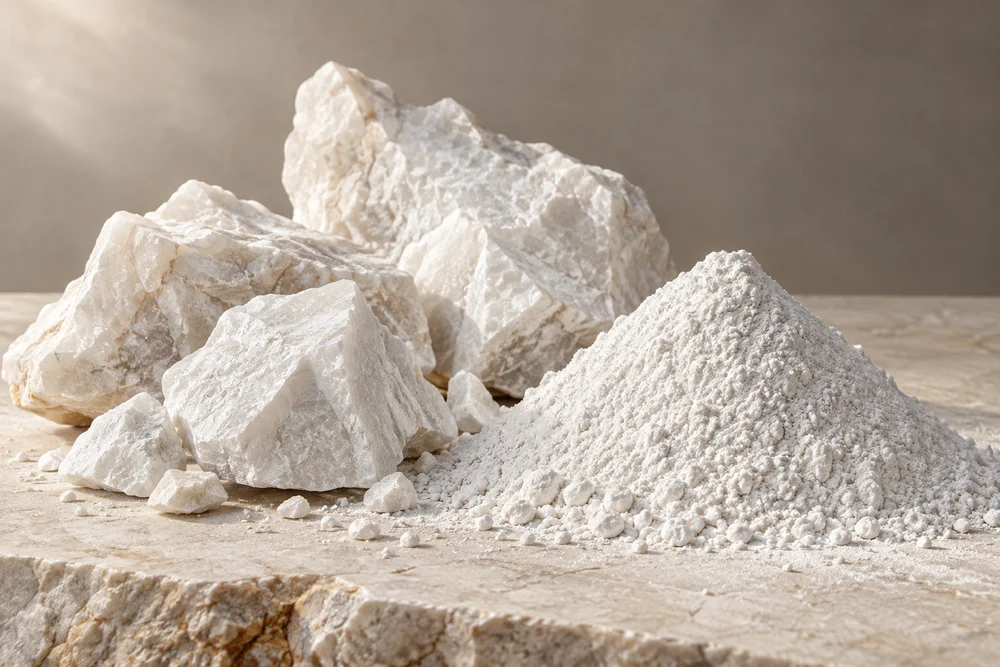
Calcite
Natural calcium carbonate is used as a mineral filler in many formulations. Particle size, whiteness, moisture and surface treatment are evaluated for each application.
View calcite01Plastics & polymers
PVC profiles and pipes
Role in the application
Calcite is a widely used mineral filler in polymer formulations. The right grade is selected together with the polymer type, production method and end-product requirements.
Mineral fillers help balance cost, opacity and processability targets. Certain film applications require grades with a specific particle-size distribution.
Key selection criteria
- Particle size and distribution
- Moisture and surface treatment
- Polymer compatibility and dispersion
Tell us your polymer type, processing method and end product.
Request information for this application02Paints & coatings
Water-based paints
Role in the application
Calcium carbonate is used as a filler in paints and coatings. Particle properties influence surface appearance and formulation behaviour.
Particle size and distribution are assessed against opacity, surface appearance and rheology targets. The choice is made together with the binder system.
Key selection criteria
- Particle size
- Whiteness and oil absorption
- Binder system and rheology
Specify your paint type, binder system and target finish.
Request information for this application03Paper & board
Paper filling
Role in the application
Calcite is used both as a filler and as a coating pigment in paper production. The grade depends on the production stage and target paper properties.
Calcium carbonate plays a role in formulations targeting whiteness, brightness and print performance. Filler and coating applications may have different technical requirements.
Key selection criteria
- Whiteness and optical properties
- Particle-size distribution
- Filler / coating requirements
Tell us the paper type and the production stage where calcite will be used.
Request information for this application04Construction materials
Mineral filler systems
Role in the application
Calcium carbonate is used as a mineral filler in construction formulations. The filler grade is selected according to the binder and application method.
Particle-size distribution, filler loading and mixing properties are considered together. Application requirements determine the physical form and material selection.
Key selection criteria
- Particle-size distribution
- Binder and mixture compatibility
- Filler loading and application
Describe your end product, binder type and application method.
Request information for this application05Rubber & elastomers
Rubber compounds
Role in the application
Calcite is one of the mineral fillers used in rubber and elastomer compounds. Selection depends on the formulation and processing conditions.
Mineral filler loading and dispersion are considered alongside the target compound properties. Suitability is confirmed through trials using the chosen elastomer and end product.
Key selection criteria
- Elastomer type
- Dispersion and particle structure
- Filler loading and formulation
Tell us your elastomer type and target compound properties.
Request information for this application06Adhesives & sealants
Adhesives
Role in the application
Calcium carbonate is used as a functional mineral filler in adhesive, mastic and sealant formulations. The binder system is a key factor in product selection.
Moisture, surface treatment and particle properties are evaluated against dispersion, viscosity and processing targets. Product moisture is particularly important in moisture-sensitive systems.
Key selection criteria
- Moisture and surface treatment
- Particle size and viscosity
- Binder-system compatibility
Specify your binder type, application and target viscosity.
Request information for this applicationThese application descriptions provide general information. The suitability of a specific product grade is assessed against your formulation and process conditions.